Happy Valentine’s Day Greeting Heart
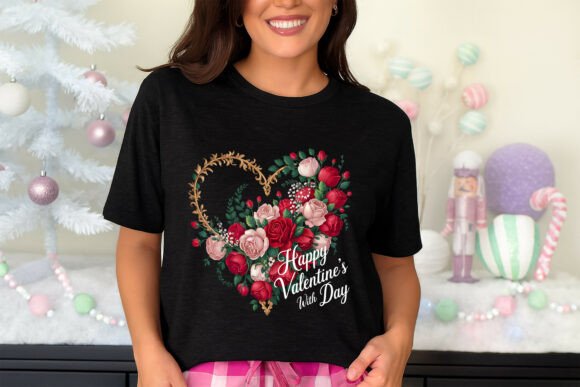
This Happy Valentine’s Day Greeting Heart is more than a festive graphic—it’s a versatile, production-ready creative asset designed for real-world use. At its core sits a lush heart-shaped bouquet of red and pink roses intertwined with delicate greenery, set against a deep black background and framed by an elegant golden ornate border. The “Valentine’s Day” text anchors the composition with quiet confidence. Delivered as a single 4096×4096 pixel PNG file at 300 dpi with full transparency, it’s built for precision—whether you’re printing on fabric, etching onto ceramic, or layering into digital layouts.
Why This Design Works Across Contexts
Its strength lies in intentional contrast and balanced hierarchy. The black background ensures clarity on any surface—no worrying about clashing with underlying colors. The gold border adds sophistication without overwhelming; it reads as timeless, not trendy. And the floral heart? It’s detailed enough to hold visual interest at scale, yet simplified enough to retain legibility when resized for small-format applications like enamel pins or sticker sheets.
Because it includes a transparent background, you’re never locked into a fixed layout. You can drop it into a mockup of a linen napkin, overlay it on a watercolor-textured greeting card, or composite it into a social media post with layered typography—all without clipping masks or tedious cleanup.
Creative Applications That Deliver Real Value
Designers and small business owners consistently find high-utility use cases in everyday production workflows:
- T-shirts & apparel: Print it centered on soft cotton tees for boutique collections—or reverse it to white-on-black for minimalist streetwear. Its clean edges prevent ink bleed during screen printing.
- Home decor: Resize it for vinyl cutting (wall decals, mirror accents) or convert it to a repeat pattern for throw pillow covers. The gold outline translates beautifully to foil stamping on canvas or linen.
- Stationery & party items: Use it as a focal seal on handmade invitations, place cards, or favor tags. For digital events, embed it into Zoom backgrounds or email headers—its resolution holds up even when scaled down for mobile previews.
- Embroidery & craft projects: While not a vector file, its high-resolution raster format supports digitizing workflows. Many embroidery studios accept 300 dpi PNGs as source art for converting to stitch files—just ensure your provider confirms compatibility.
How Different Users Can Adapt It Thoughtfully
For educators and workshop leaders: Integrate the graphic into printable Valentine’s Day lesson kits—pair it with editable text boxes for student name tags or kindness pledge cards. Its visual warmth supports social-emotional learning themes without feeling infantilized.
For marketers and bloggers: Repurpose it across campaign assets: crop the heart alone for Instagram Story highlights, extract the gold border as a framing element for blog banners, or isolate the rose cluster for email newsletter dividers. Because it’s a single-layer PNG, there’s no risk of misaligned layers or missing fonts.
For freelancers and print-on-demand sellers: Test variations before committing to inventory. Try recoloring the roses using adjustment layers in Photoshop (e.g., shifting pinks toward mauve for a modern twist), or pair it with complementary patterns—think subtle herringbone or dot grids—to create cohesive product suites (mugs + coasters + tote bags).
Practical Tips for Consistent, Audience-Friendly Results
Color accuracy matters—but it’s contextual. The file renders true-to-design on calibrated monitors, yet printed output will vary depending on paper stock, ink type, and printer calibration. If consistency across products is critical (e.g., matching a branded color palette), order physical proofs before bulk runs. For web use, export lightweight WebP versions for faster loading—keeping the original PNG intact for editing.
When adapting for accessibility, remember contrast ratios. Against white or light backgrounds, the black base may need a subtle drop shadow or light stroke to maintain readability. Likewise, avoid placing the full composition over busy photos or gradients unless intentionally creating layered depth.
Keep version control simple: rename files clearly (e.g., “Valentine_Heart_RoseGold_4096px_Transparent.png”) and store backups in cloud-synced folders with dated subfolders. This avoids confusion when pulling assets for seasonal campaigns year after year.
Thinking Beyond the Obvious Use Cases
Consider how this design supports storytelling—not just decoration. A wedding planner might use it as a subtle watermark on vendor proposal PDFs, signaling care and attention to romantic detail. A therapist offering couples’ workshops could feature it on handouts about emotional connection, letting the imagery reinforce theme without overt sentimentality.
It also works well in hybrid analog-digital contexts. Print it on textured cardstock, then film a stop-motion video of hands assembling a physical card around the cut-out heart—ideal for TikTok or Reels content that showcases process and personality.
And because it’s delivered as an instant digital download—with no physical item shipped—you eliminate shipping delays, customs fees, or inventory overhead. That immediacy supports rapid iteration: test a concept Monday, finalize Friday, launch Saturday.
A Final Note on Creative Integrity
Using a ready-made graphic like the Happy Valentine’s Day Greeting Heart doesn’t shortcut originality—it redirects energy. Instead of spending hours building a floral heart from scratch, you invest time in thoughtful adaptation: choosing the right substrate, pairing it with intentional typography, or designing a full customer journey around it. That’s where distinction lives—not in starting from zero, but in applying judgment, context, and care.
Whether you’re launching a limited-edition collection, preparing classroom materials, or building a brand voice for February, this asset gives you a strong, beautiful foundation. Build on it deliberately—and let the heart do what hearts do best: connect, resonate, and remain memorable.